

Reaching for a bottle on the top shelf. Brushing your hair. Shrugging on a jacket. You do these things a dozen times a day without a second thought, until your shoulder starts to hurt. Then every reach turns into a small negotiation.
Shoulder pain when lifting your arm can affect far more than your reach. It can disturb your sleep, slow you down at work and make everyday tasks harder than they should be. In adults over 40, one of the most common culprits is the rotator cuff [1,2].
The rotator cuff is a group of four muscles and their tendons that keep your shoulder steady and control how your arm moves. When those tissues become irritated or injured, simple movements like raising your arm or reaching overhead can start to hurt [1,2].
This guide explains what the rotator cuff does, why lifting your arm hurts, the most common causes of rotator cuff pain, the warning signs that need a doctor, and how physiotherapy can help.
What Is the Rotator Cuff?
Your shoulder is built for range. It lets you reach overhead, reach behind your back and turn your arm in and out. The trade-off is stability. Because the shoulder socket is shallow, the joint is naturally less stable than many others in the body.
That's where the rotator cuff comes in. It holds the top of your upper arm bone in the right position while still letting the shoulder move freely [1,2].
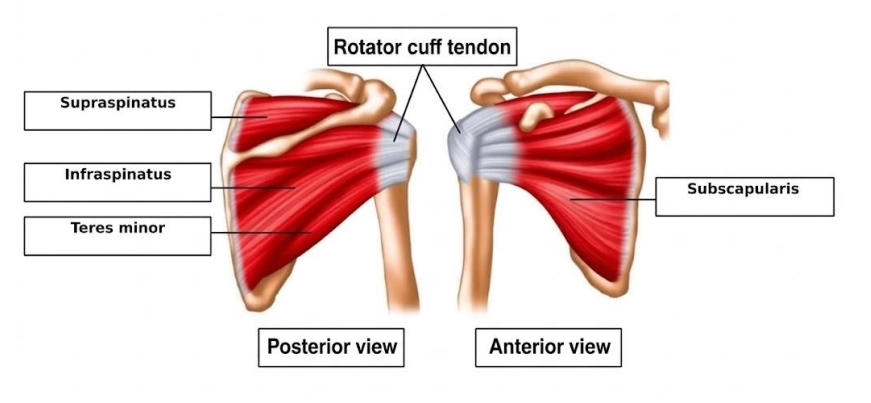
The four rotator cuff muscles
| Muscle | What it does |
|---|---|
| Supraspinatus | Lifts your arm out to the side |
| Infraspinatus | Turns your arm outward |
| Teres minor | Also turns your arm outward |
| Subscapularis | Turns your arm inward |
Together, these muscles support the shoulder and guide your arm through everyday tasks like reaching for a high shelf, putting on a jacket or lifting a bag of groceries. When the rotator cuff is irritated or injured, those same movements can become painful. Some people also notice their arm feels weak when they lift or carry things [1,2].
Why Does Lifting Your Arm Hurt?
Raising your arm looks simple, but it takes several muscles and tendons working as a team. When the rotator cuff is involved, there are three main reasons you might get shoulder pain when lifting your arm.
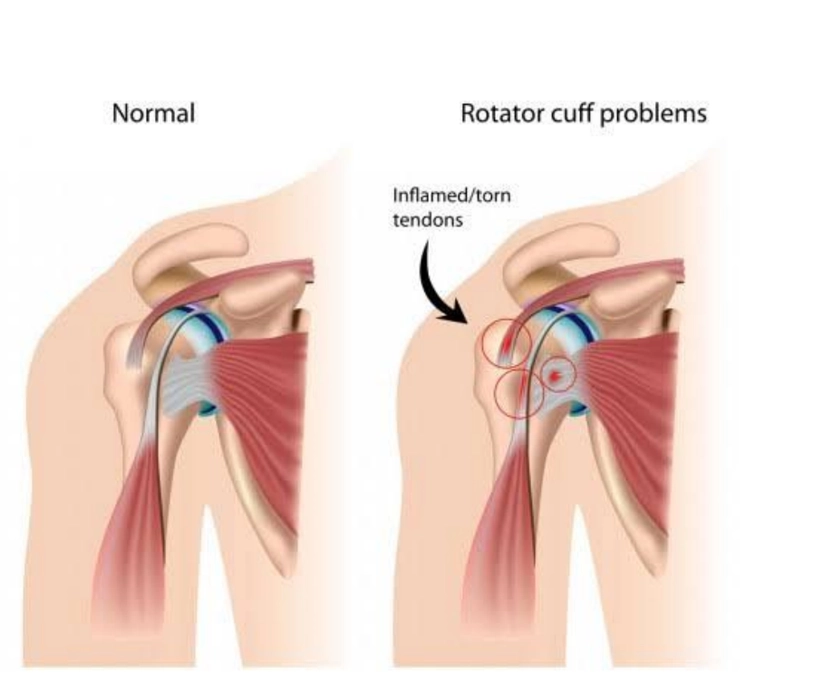
1. The tendon travels through a tight space
The supraspinatus, the rotator cuff muscle that helps lift your arm, has a tendon that runs underneath a bony part of the shoulder blade called the acromion.
If that tendon or the tissues around it are irritated, lifting your arm puts more load on them, and that can hurt. Some people feel it most when their arm is somewhere between shoulder height and overhead. Clinicians call this a painful arc [3,4].
That said, shoulder pain doesn't always mean a tendon is being pinched. Tendon sensitivity, changes in how the shoulder works and the amount of load you put through it can all play a part.
2. Your shoulder muscles need to work together
When you raise your arm, the large deltoid muscle does the lifting while the rotator cuff keeps the ball of your upper arm bone steady in its socket.
If the rotator cuff is sore, weak or injured, it struggles to control that movement. Your arm may move differently as a result, and that can add to the pain when you lift it [1,3].
3. The tendon becomes more sensitive
An affected rotator cuff tendon can become more sensitive to movement and load. So reaching overhead, brushing your hair or pulling on a shirt may start to hurt [5,6].
You may have heard this called tendonitis, a term that suggests inflammation. Today, clinicians often use the word tendinopathy for longer-lasting tendon problems, because they can involve changes in the tendon's structure and how it works. Inflammation isn't always the main driver [5].
Common Causes of Rotator Cuff Pain
Three problems turn up most often: tendinopathy, subacromial pain and rotator cuff tears. They can overlap, and you can have more than one at the same time [7].
Rotator cuff tendinopathy
Rotator cuff tendinopathy happens when the tendons become painful and their structure changes. It often builds up gradually, without one clear injury. Age-related changes and repeated overhead activity can both contribute [7].
Think of a rope that frays after years of use. It's a useful picture, but it's only part of the story. Tendon problems aren't caused by wear and tear alone: age, diabetes, how active you are and other personal factors can all play a role [7].
Subacromial pain (formerly called impingement syndrome)
Subacromial pain is pain around the shoulder that often gets worse when you lift your arm. It can involve the rotator cuff tendons, the bursa (a small fluid-filled cushion) or other tissues nearby [7].
For years, this was called impingement syndrome, based on the idea that tissues get squeezed as the arm moves. But shoulder pain is more complex than simple pinching between bones, so many clinicians now use the broader term rotator cuff–related shoulder pain to cover these overlapping problems [7].
Rotator cuff tears
A rotator cuff tear happens when one or more tendons tear partly or all the way through. Some tears develop slowly as the tendon changes with age. Others happen suddenly, after a fall onto the arm or an awkward heavy lift.
A tear can cause pain, weakness and trouble lifting the arm. But not every tear causes symptoms, and scans of shoulders with no pain at all can still show tendon changes [8]. That's why imaging results should always be read alongside your symptoms and a clinical examination [7].
When Should You See a Doctor?
See a doctor promptly if you notice any of these red flags [2]:
- pain after a fall, accident or sudden injury
- you can't lift your arm at all
- severe pain or sudden swelling within hours
- night pain that keeps waking you, even with rest
- significant weakness that affects daily tasks
- no improvement after 2–3 weeks of self-care
Your GP can assess your shoulder, order imaging such as an X-ray, ultrasound or MRI, refer you to physiotherapy, or send you to an orthopaedic specialist if a tear needs a surgical opinion [2].
Timing matters for one group in particular. If you're younger and active and you tear your rotator cuff in an injury, ask for an early orthopaedic review. Surgical repair tends to give better results when it's done within the first few weeks, especially for full-thickness tears in people who need to get back to overhead sport or manual work [2].
Physiotherapy and Chiropractic Care: How They Work Together
Physiotherapy comes first
For most rotator cuff pain, physiotherapy is the recommended first-line treatment. The 2025 JOSPT clinical practice guideline gives exercise therapy a Grade A recommendation, its highest, and treats it as a core part of care that should include progressive strengthening and exercises to improve shoulder control [7,9]. A 2024 review in the same journal found that exercise programs focused on shoulder control (motor control exercises) probably work slightly better than general exercise for reducing disability [10].
When chiropractic care can help
Chiropractic care can complement physiotherapy when:
- neck pain, upper-back stiffness or posture problems come along with your shoulder pain
- joint mobilisation could help restore movement in your shoulder or upper back
- you respond well to hands-on treatment alongside your exercise program
A practical recovery plan
- Start with physiotherapy-led exercise as your foundation.
- Add chiropractic care if neck or posture problems persist, or if progress stalls after 4–6 weeks.
- Keep both practitioners in the loop so your treatments support each other rather than clash [3,7].
- If your pain hasn't improved after 6 weeks of combined care, go back to your doctor for a reassessment and possibly imaging.
Frequently Asked Questions
Why does my shoulder hurt when I lift my arm?
In adults over 40, a common reason is an irritated or injured rotator cuff. Lifting your arm loads the rotator cuff tendons, especially the supraspinatus as it passes under the acromion, and a sore or weak rotator cuff struggles to control the movement [1–4].
Is rotator cuff tendinopathy the same as tendonitis?
Not quite. Tendonitis implies inflammation, while tendinopathy describes longer-lasting tendon problems that involve changes in the tendon's structure and function. Inflammation isn't always the main cause [5].
Do I need a scan for shoulder pain?
Not always. Your doctor may order an X-ray, ultrasound or MRI if your symptoms or examination call for one [2]. Scan results are only part of the picture, because tendon changes can show up even in shoulders that don't hurt [7,8].
How long should I wait before getting my shoulder checked?
See a doctor straight away if you have any of the red flags above. Otherwise, get it checked if your shoulder hasn't improved after 2–3 weeks of self-care [2].
The Bottom Line
Shoulder pain when lifting your arm is often linked to the rotator cuff, the small group of muscles and tendons that keeps your shoulder stable as it moves. Tendinopathy, subacromial pain and tears are the usual suspects, and they often overlap.
The encouraging part is that, for most people, a guided exercise program with a physiotherapist is the best place to start. If your shoulder has been bothering you for a while, or you've spotted any of the red flags above, don't wait it out. Book an assessment with The Art of Physio in Petaling Jaya by WhatsApp on 011-1088 1713, and get a plan built around your shoulder.
References
- Brukner P, Khan K. Brukner & Khan's Clinical Sports Medicine. 5th ed. Sydney: McGraw-Hill; 2017.
- Mitchell C, Adebajo A, Hay E, Carr A. Shoulder pain: diagnosis and management in primary care. BMJ. 2005;331(7525):1124–1128. doi:10.1136/bmj.331.7525.1124
- Umer M, Qadir I, Azam M. Subacromial impingement syndrome. Orthopedic Reviews (Pavia). 2012;4(2):e18. doi:10.4081/or.2012.e18
- Hanchard NCA, Lenza M, Handoll HHG, Takwoingi Y. Physical tests for shoulder impingements and local lesions of bursa, tendon or labrum that may accompany impingement. Cochrane Database of Systematic Reviews. 2013;(4):CD007427. doi:10.1002/14651858.CD007427.pub2
- Cook JL, Purdam CR. Is tendon pathology a continuum? A pathology model to explain the clinical presentation of load-induced tendinopathy. British Journal of Sports Medicine. 2009;43(6):409–416. doi:10.1136/bjsm.2008.051193
- Lewis J, McCreesh K, Roy J-S, Ginn K. Rotator cuff tendinopathy: navigating the diagnosis–management conundrum. Journal of Orthopaedic & Sports Physical Therapy. 2015;45(11):923–937. doi:10.2519/jospt.2015.5941
- Desmeules F, Roy J-S, Lafrance S, et al. Rotator cuff tendinopathy diagnosis, nonsurgical medical care, and rehabilitation: a clinical practice guideline. Journal of Orthopaedic & Sports Physical Therapy. 2025. doi:10.2519/jospt.2025.13182
- Miniaci A, Dowdy PA, Willits KR, Vellet AD. Magnetic resonance imaging evaluation of the rotator cuff tendons in the asymptomatic shoulder. American Journal of Sports Medicine. 1995;23(2):142–145. doi:10.1177/036354659502300202
- Diercks R, Bron C, Dorrestijn O, et al. Guideline for diagnosis and treatment of subacromial pain syndrome: a multidisciplinary review by the Dutch Orthopaedic Association. Acta Orthopaedica. 2014;85(3):314–322. doi:10.3109/17453674.2014.920991
- Lafrance S, Charron M, Dubé M-O, et al. The efficacy of exercise therapy for rotator cuff–related shoulder pain according to the FITT principle: a systematic review with meta-analyses. Journal of Orthopaedic & Sports Physical Therapy. 2024;54(8):499–512. doi:10.2519/jospt.2024.12453